Introduction
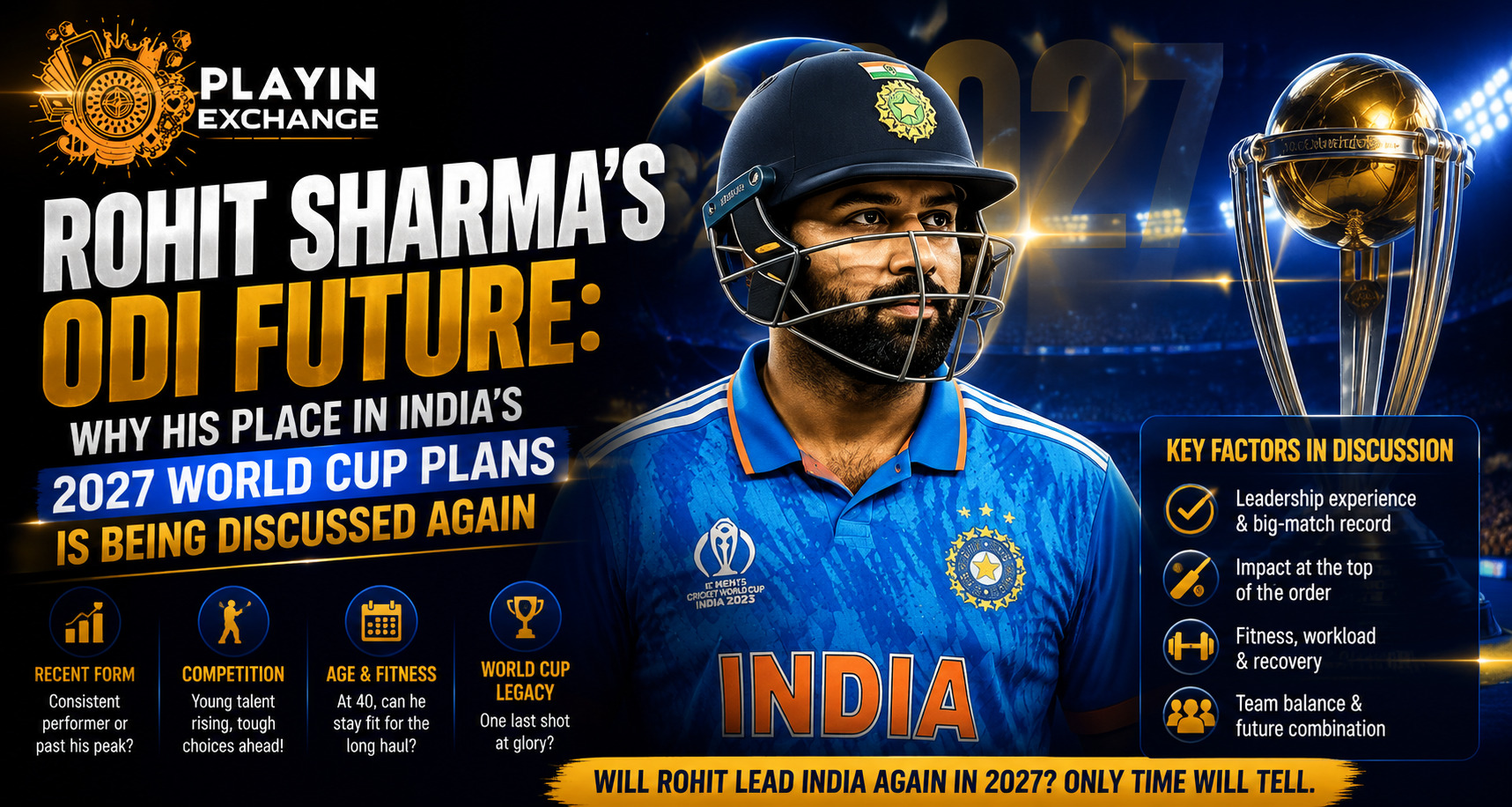
Rohit Sharma’s ODI future has once again become a major talking point as India continue preparing for the 2027 World Cup. Despite ongoing discussions about his age and long-term availability, Rohit remains part of India’s ODI plans and was included in the squad for the 2026 England series. For readers following Playexch cricket updates, the question is no longer simply whether Rohit can continue, but how India can balance his experience with the development of their next generation.
Rohit also answered some of the recent retirement speculation with his performances in England, including a memorable century at Lord’s. India’s ODI captain Shubman Gill subsequently said there had been no discussion within the team about Rohit retiring from ODI cricket.
Why Rohit’s ODI Future Is Being Discussed Again
At 39, Rohit is naturally being assessed as India plan for a World Cup that begins in 2027. However, age alone does not determine selection.
His recent ODI performances remain relevant. Against England at Lord’s in July 2026, Rohit produced a score of 138 while chasing a demanding target. His performance came after criticism surrounding his form and demonstrated that he could still make a major contribution at international level.
That creates an important selection question: should India continue building around Rohit while he remains productive, or begin moving more aggressively towards younger alternatives?
Rohit Still Offers Valuable Experience
One of Rohit’s biggest advantages is his experience at major international tournaments.
He has:
- Played in multiple ODI World Cups
- Led India in major tournaments
- Experience opening against different bowling attacks
- Extensive knowledge of ODI match conditions
- Experience handling high-pressure situations
India’s bowling coach Morne Morkel also recently highlighted the calmness and experience Rohit brings to the top of the batting order.
For a World Cup campaign, those qualities can be difficult to replace.
His Recent ODI Form Gives Him a Strong Argument
The strongest argument for Rohit is performance. During the England ODI series, he finished with an important century at Lord’s, and ICC’s July rankings update noted that his 138 helped him remain among the top-ranked ODI batters.
That innings demonstrated that Rohit can still produce a match-defining performance when the situation demands it.
However, India’s selectors will need to assess consistency across the full period leading to the World Cup rather than relying on one outstanding innings.
Shubman Gill Represents the Next Generation
While Rohit remains involved, India’s leadership structure has already moved towards the next generation.
Shubman Gill was appointed India’s ODI captain and led the side during the England series. The BCCI’s official squad also listed Rohit and Virat Kohli alongside Gill, showing that India were willing to combine established experience with younger leadership.
This arrangement allows Gill to develop as captain while senior players continue contributing on the field.
India Are Not Making an Immediate Generational Shift
India’s recent ODI selections suggest that the team is taking a gradual approach rather than replacing senior players immediately.
The England ODI squad included:
- Shubman Gill
- Rohit Sharma
- Virat Kohli
- Shreyas Iyer
- KL Rahul
- Ishan Kishan
The selection shows that experienced players remain part of the team’s plans while younger options are gradually being assessed.
What Could Decide Rohit’s World Cup Place?
Rohit’s eventual selection will depend on more than reputation.
The selectors are likely to consider:
- ODI performances
- Fitness
- Workload
- Batting consistency
- Ability to handle different conditions
- Team balance
- Availability of younger opening options
If he maintains strong performances, his experience could remain difficult to overlook.
The Opening Partnership Will Be Important
India’s opening combination will be one of the major areas to monitor before the 2027 World Cup.
Rohit provides an aggressive option at the top, while India also have younger batters who could compete for positions.
The selectors will need to determine which combination offers the best balance between experience, scoring ability and long-term planning.
Rohit’s Role Could Become More Defined
India do not necessarily need Rohit to play every ODI leading into the World Cup. A carefully managed schedule could allow him to remain fresh for important matches while giving younger players opportunities elsewhere.
That could help India achieve two objectives at once:
- Preserve Rohit’s experience
- Develop reliable alternatives
Such an approach would also give selectors more information before finalising the 2027 squad.
India’s Home Schedule Offers More Opportunities
India’s 2026–27 home schedule includes three-match ODI series against the West Indies and Sri Lanka, followed by a three-match ODI series against Zimbabwe in January 2027. These matches could provide further opportunities to assess the ODI squad before the World Cup.
This schedule could be particularly useful for testing different opening combinations and backup options.
Competition Can Strengthen the Squad
The presence of experienced players does not necessarily restrict younger talent. Instead, competition for places can encourage players to perform consistently.
Rohit’s continued involvement gives younger batters an opportunity to learn from an experienced international opener while also understanding that places must ultimately be earned through performance.
What the Selection Strategy Suggests
India’s current approach suggests that the selectors are keeping their options open.
Rohit has not been pushed out of the ODI setup, Gill has taken on the captaincy, and younger players are being introduced gradually. This indicates a transition rather than an immediate rebuild.
The next year should reveal whether that balance remains effective.
Following India’s ODI World Cup Preparation
Fans using Playexchange to follow India’s ODI planning can monitor squad announcements, player form and upcoming series as the World Cup approaches. Current selection information is particularly important because India’s combination could evolve considerably before 2027.
Rather than focusing only on individual names, it is useful to watch how the opening partnership, middle order and overall squad balance develop.
Conclusion
Rohit Sharma’s place in India’s 2027 ODI World Cup plans is being discussed because the team must balance a successful present with long-term planning. Yet his recent performances provide a strong argument for continued selection. His 138 at Lord’s showed that he can still produce decisive ODI innings, while India’s coaching staff continue to value the experience and calmness he brings.
At the same time, Shubman Gill’s leadership and India’s growing depth indicate that the team is preparing for the future. The most practical approach may be to continue assessing Rohit through the upcoming ODI schedule while giving younger players opportunities to develop.
For now, his 2027 World Cup position remains open rather than settled. Consistent performances, fitness and India’s evolving team requirements will ultimately determine whether Rohit makes another World Cup appearance.
FAQs
1. Is Rohit Sharma still part of India’s ODI plans?
Yes. Rohit was included in India’s ODI squad for the 2026 England series, alongside Shubman Gill and Virat Kohli.
2. Has Rohit Sharma announced his ODI retirement?
No. In July 2026, Shubman Gill said Rohit had not told the team about any ODI retirement plans.
3. Why is Rohit’s 2027 World Cup place being discussed?
His age means India must consider long-term squad planning, but his recent performances also give the selectors reasons to continue considering him.
4. How did Rohit perform against England in 2026?
Rohit scored 138 at Lord’s in the third ODI against England, producing an important innings while India chased a large total.
5. Who is India’s current ODI captain?
Shubman Gill is India’s ODI captain. He led the team during the 2026 England ODI series.
6. Could India give younger openers more opportunities?
Yes. India’s upcoming ODI schedule provides several opportunities to test younger players while continuing to evaluate the established core.