
Introduction
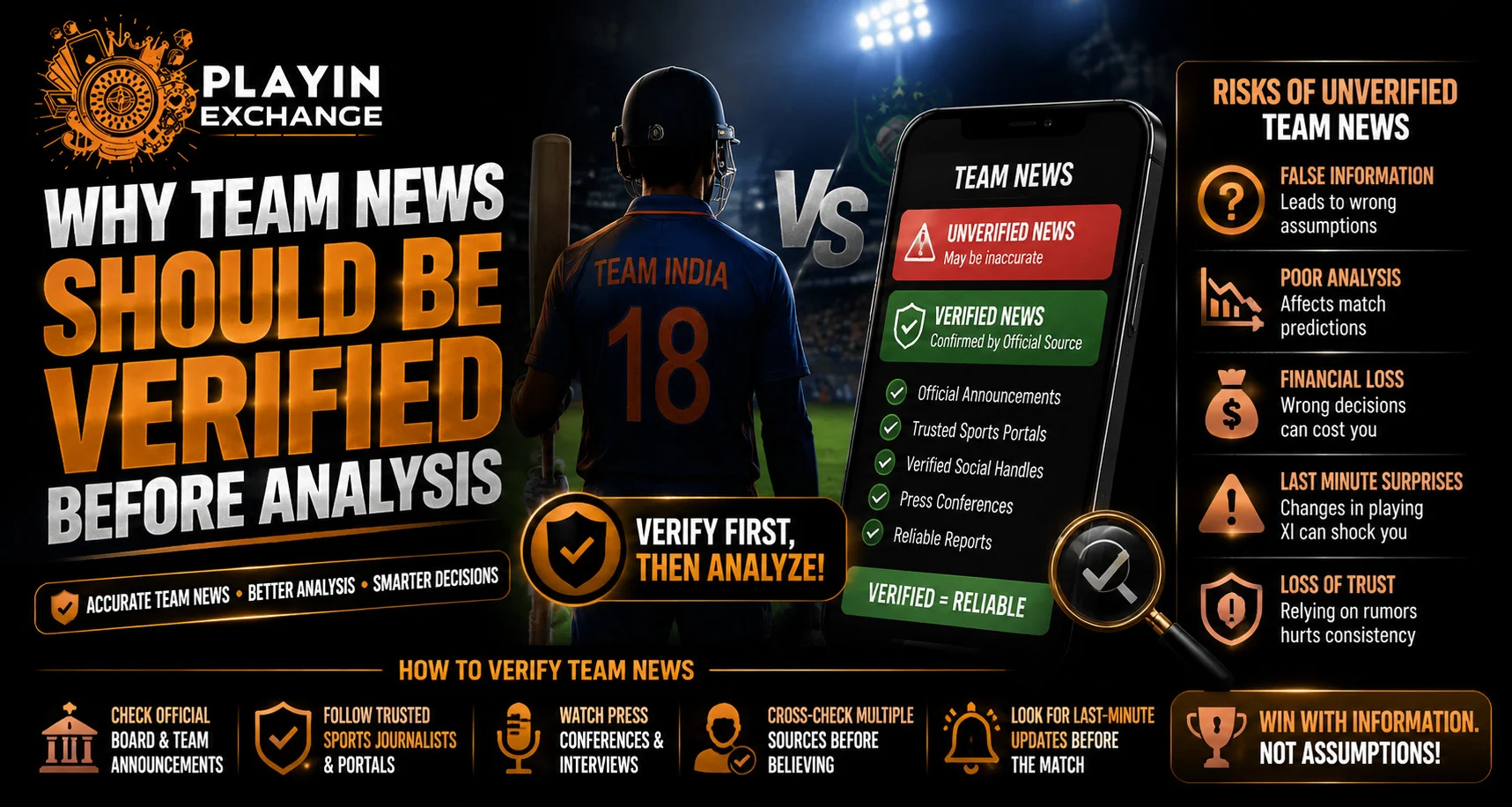
Team news can strongly influence how a sports match is understood before it begins. Injuries, player availability, lineup changes and tactical decisions may change the expected balance between two sides. For readers following Playexch cricket updates, verifying the latest team information before starting an analysis helps prevent conclusions based on outdated or incomplete reports.
A detailed preview can still be misleading if it is based on a player who has already been ruled out or a lineup that has changed. Reliable analysis should therefore begin with accurate information.
What Counts as Team News?
Team news covers information that can affect the players available for a match or their expected roles.
It can include:
- Injury updates
- Squad announcements
- Confirmed playing XI
- Player suspensions
- Rest decisions
- Captaincy changes
- Fitness reports
- Tactical selections
Not all team news carries the same level of certainty. This is why the source and wording should always be considered.
Why Verification Matters
Sports information can change rapidly, especially close to match time. A player who is expected to participate may later be ruled out after a final fitness assessment.
Using outdated information can affect an entire analysis.
Verification helps confirm:
- Which players are available
- Which players are absent
- How the batting order may look
- Which bowlers are expected to play
- Whether recent team news is still valid
Accurate information provides a stronger foundation for assessing the match.
Start With the Original Source
When an important team update appears online, try to identify its original source.
Useful sources include:
- Official cricket boards
- Team websites
- Tournament organisers
- Official team social-media accounts
- Confirmed press conferences
- Reputable sports publications
A report from an official team channel generally carries more weight than an unsourced social-media post.
Confirmed News vs Predictions
One of the easiest ways to misunderstand team news is to confuse a prediction with a confirmed announcement.
Words such as “confirmed”, “selected” and “ruled out” generally indicate established information.
On the other hand, phrases such as:
- Could play
- May miss
- Expected to feature
- Likely to start
- Reportedly
usually indicate uncertainty.
A predicted lineup should never automatically be treated as the official playing XI.
Check the Publication Date
An article can be accurate when published but outdated later.
This is particularly common with injury and selection stories. A morning report may describe a player as doubtful, while a later update could confirm that the player is fit to participate.
Before using a report, check:
- Publication date
- Publication time
- Update timestamp
- Latest official announcement
- Match-day developments
The most recent reliable information should normally take priority.
Verify Injury and Fitness Updates
Injury information requires particular care because several different stages can exist.
A player may be:
- Under assessment
- Recovering
- Doubtful
- Fit to train
- Fit to play
- Ruled out
These terms are not interchangeable. Returning to training does not necessarily mean a player has been cleared for competitive action.
Checking the latest official update can prevent incorrect assumptions.
Confirm the Playing XI
The confirmed playing XI is one of the most valuable pieces of information for match analysis.
Once the XI is announced, analysts can assess:
- Opening combination
- Middle-order structure
- Wicketkeeper
- All-rounder options
- Pace attack
- Spin resources
- Batting depth
Before confirmation, analysts can discuss possible combinations, but they should clearly label them as predictions.
Team News Can Change Tactical Analysis
A team selection can reveal more than which players are available. It can also provide clues about the strategy a captain and coaching staff intend to use.
For example, selecting an extra spinner may indicate confidence in the pitch conditions. Adding another fast bowler may suggest that the team expects movement or wants greater pace options.
The playing XI can therefore help analysts understand tactical intentions.
Do Not Depend on One Social-Media Post
Social media is useful for discovering breaking news, but it can also spread incorrect information quickly.
Before accepting a major claim, ask:
- Who published it?
- Is the account official?
- Is there an original source?
- Are reputable outlets reporting the same information?
- Has the team confirmed the update?
This short verification process can prevent an unverified claim from becoming the foundation of an entire analysis.
Compare Multiple Reliable Reports
When news is important, comparing several reputable sources can provide additional confidence.
For example, if multiple established publications report the same injury update and the team later confirms it, the information is much stronger than a single anonymous post.
However, comparing sources should not mean repeating the same unverified claim from several websites. Ideally, the reports should trace back to an identifiable and credible source.
Consider the Match Context
Verified team news is only the starting point. After confirming availability, analysts should consider how the changes affect the actual match.
Important factors can include:
- Player roles
- Opposition matchups
- Venue
- Pitch conditions
- Recent form
- Batting depth
- Bowling balance
A missing player may be significant, but the replacement can sometimes offer a different tactical advantage.
Avoid Immediate Conclusions
A late team change does not automatically determine the match result.
For example, the absence of a leading batter may appear negative, but another player could take advantage of the opportunity. A team may also change its strategy to compensate for the missing player.
Good analysis should therefore examine the complete team structure rather than reacting to a single headline.
Using Current Match Information
Readers following cricket through Playexchange can compare confirmed team announcements with recent statistics, player roles and match conditions before forming an assessment. This is particularly useful when a late injury or selection change alters the expected balance of a contest.
Current information should take priority over an older prediction, especially close to the start of a match.
How Team Changes Affect Player Markets
Changes to the playing XI can also affect expectations around individual players. A batter moving higher in the order may receive a different opportunity from the one originally expected, while a bowler selected for a specific role may receive additional overs.
Therefore, analysts should reassess player roles whenever the official lineup changes.
This is another reason why relying on an early predicted XI can create misleading conclusions.
A Simple Verification Process
Before analysing a cricket match, follow a straightforward process:
- Find the latest official team update.
- Confirm player availability.
- Check the expected or confirmed playing XI.
- Review recent injury and fitness information.
- Compare important updates with reputable sources.
- Reassess the team balance after any changes.
- Begin the detailed analysis only after the key information is verified.
This process reduces the risk of building an argument around incorrect information.
Conclusion
Team news is one of the most important foundations of sports analysis, but only when it is accurate and current. Injuries, playing XI changes, fitness updates and tactical selections can all change how a match should be assessed.
Verifying the original source, checking the publication time and separating confirmed information from predictions can help create clearer and more reliable analysis. Readers should also remember that a lineup change does not automatically determine the result.
The simple rule is to verify first and analyse second.
FAQs
1. Why should team news be verified before analysis?
Incorrect or outdated team news can lead to wrong assumptions about player availability, team balance and match strategy.
2. What is the best source for confirmed team news?
Official team websites, cricket boards, tournament organisers and verified team announcements are among the strongest sources.
3. Can injury news change shortly before a match?
Yes. A player’s fitness can be reassessed close to the match, so older reports may no longer reflect the current situation.
4. Is a predicted playing XI the same as a confirmed XI?
No. A predicted XI is an expected lineup, while a confirmed XI is officially announced by the team.
5. Why should analysts check the publication date?
Team information can change quickly. The publication date helps determine whether a report is still current.
6. Can one team-selection change affect a match analysis?
Yes. A single selection change can alter batting order, bowling roles, team balance and tactical plans, so the analysis may need to be updated.


